Hybrid Cooling: Where Power Meets Efficiency in Data Centres
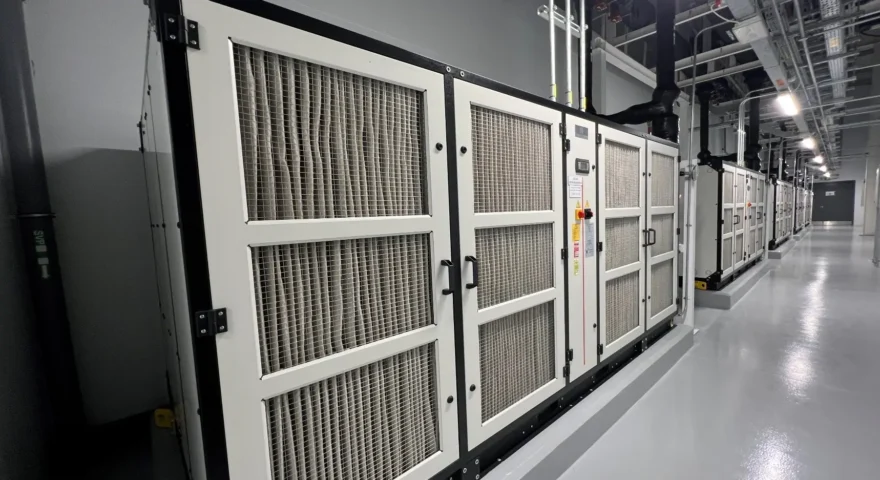
Designing cooling systems for data centres is straightforward when the end user’s requirements are known. The real engineering challenge arises when they are not. For developers delivering speculative or multi-tenant data centres, the eventual IT load, rack density, and cooling philosophy may change several times before the facility is fully occupied. Designing around a single cooling strategy in these circumstances can create operational constraints, inefficiencies, or costly retrofits. Hybrid cooling offers a more resilient solution.
The Uncertainty Problem
Modern data centres are evolving rapidly. Rack densities that once averaged 5-10 kW are now commonly 30 kW and beyond, while AI and high-performance computing deployments can exceed 80-100 kW per rack. Without clarity on the future tenant profile, committing to either traditional air cooling or full liquid cooling can be risky.
Air systems may struggle with ultra-high-density loads. Conversely, fully engineered liquid cooling infrastructure may remain underutilised for years if tenants deploy standard enterprise IT. This uncertainty requires flexibility built into the mechanical design from day one.
What Hybrid Cooling Means
Hybrid cooling is not simply mixing technologies. It is a deliberate design strategy that allows multiple cooling methodologies to coexist and scale as demand evolves. In practice, this typically involves:
- High-efficiency air cooling to support conventional IT loads across the white space
- Liquid-ready infrastructure such as facility water loops, secondary cooling distribution, and spare capacity for future CDU (Coolant Distribution Unit) deployment
- Modular plant design allowing incremental upgrades as rack densities increase
- Adaptable containment and airflow management that can transition between cooling approaches
The result is a platform rather than a fixed solution.
Why It Matters
A well-designed hybrid system delivers three key advantages:
- Future readiness – The facility can support both conventional enterprise deployments and next-generation high-density workloads without structural redesign.
- Energy performance – Cooling plant can be optimised for the actual load profile rather than over-designed for a hypothetical future state. This improves overall PUE and reduces wasted capacity.
- Commercial flexibility – Operators can attract a wider tenant base by offering infrastructure capable of supporting different cooling strategies.
Effective Early Engineering
Hybrid cooling only works if it is considered early in the building services design. Key factors include:
- Plantroom capacity and pipework distribution strategy
- Hydraulic separation between building cooling systems and potential liquid loops
- Space planning for CDUs and rear-door heat exchangers
- Power and redundancy strategies aligned with evolving cooling loads
- Integration with BMS and monitoring systems
- Without this foresight, retrofitting liquid-ready infrastructure later can be complex and expensive.
The BSE|3D Approach
At BSE|3D, our focus is designing data centre environments that remain technically robust long after the first tenant moves in. Hybrid cooling is a clear example of where building services engineering must anticipate change rather than simply respond to it. By combining scalable plant design, flexible distribution infrastructure, and rigorous thermal modelling, we create facilities that can evolve alongside the IT they support. Because in modern data centres, cooling is no longer just about removing heat, it’s about enabling what comes next.
To learn more how BSE|3D can support with MEP for your next data centre project get in touch via mail@bse3d.com or +44 20 7193 7146.
Talk to Our Expert Team
If you would like to learn more about the range of services we offer, please get in touch for an informal discussion about your needs and requirements.